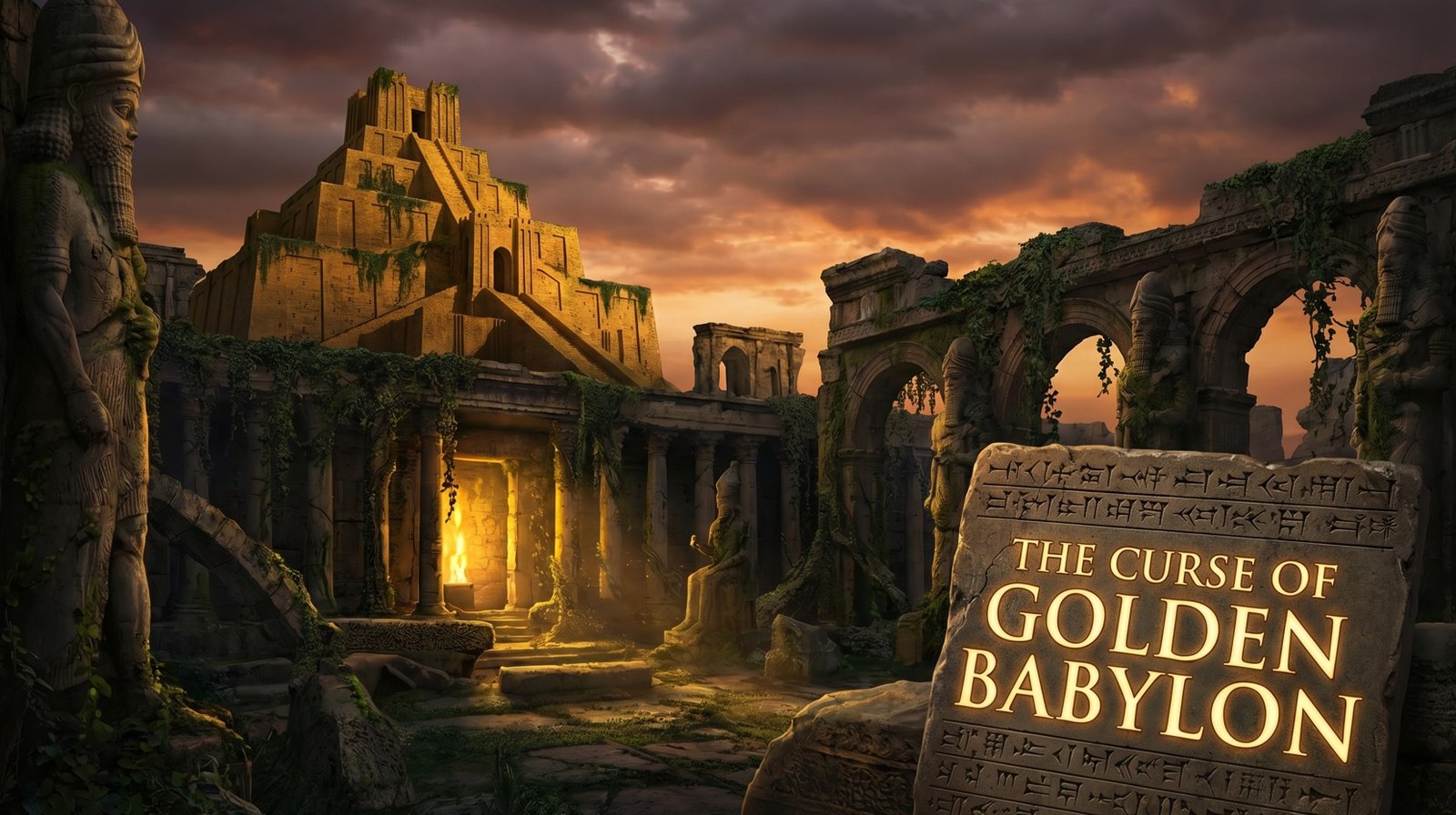
Babylon. It was loved and hated, idolized and despised. Three times it was razed to the ground, only to rise from the ashes again. Its exterior was fortified to perfection, yet it rapidly weakened from within. It was promised eternal prosperity, but it turned into a legend, descending for a long time into the underworld of oblivion.
“And Babylon, the glory of kingdoms, the beauty of the Chaldees’ excellency, shall be as when God overthrew…” This verdict was pronounced by a biblical prophet for the greatest of ancient Eastern cities—Babylon—a hundred years before it reached the pinnacle of its splendor. It struck awe into the hearts of both the small and the great, mystically mesmerizing and enchanting them with its superiority and beauty. In all of human history, no city in the world rose as high in its outward magnificence as Babylon, and none fell as low from its reached peak as Babylon.
“Gate of God”
The very name of the city, Babylon, originates from the Semitic “bab-Illu” and means “Gate of God.” Even in the first half of the nineteenth century, many scientists found it hard to believe in the reality of its existence. The testimonies of the Bible and ancient scholars and philosophers like Herodotus or Strabo were not taken seriously, as it was believed these sources were greatly exaggerating.
The City Beneath Feet
March 1899 was drawing to a close when archaeologist and architectural historian Robert Koldewey, leading an expedition commissioned by Berlin museums, reached the mysterious site that would become his life’s work after 26 days of travel. It was here, a hundred kilometers south of Baghdad—the capital of Iraq—that lifeless, flat-topped hills with steep slopes were destined to “speak” under the archaeologist’s shovel. None of the local residents knew that right there, beneath their feet and under meters of sand and rubble, lay the greatest city of all time—Babylon.
Previous attempts by several archaeologists to find anything significant in these parts had met with little success. To penetrate the secrets of Babylon required the systematic work of hundreds of laborers and dozens of scientists, with a fantastic investment of funds—far more than the cost of excavating all the already discovered ancient cities in modern-day Iraq. Thanks to the generous financial support of the German Oriental Society and the indomitable energy of Robert Koldewey, a significant portion of what remained of legendary Babylon was brought to the surface. For eighteen years, Koldewey and his team excavated the remains of the buried city, sometimes clearing piles of rubble as high as a modern nine-story building. These were the remains of Babylon at the peak of its glory and power (605–538 BC), when the great king of the Neo-Babylonian Empire from the Chaldean dynasty, Nebuchadnezzar II, ascended the throne.
The New Empire
“Is not this great Babylon, that I have built for the house of the kingdom by the might of my power, and for the honour of my majesty!” According to the Bible, Nebuchadnezzar II uttered these words while walking through his palaces in Babylon. Inscriptions of Nebuchadnezzar II with similar content were also found during the excavations. Although the city of Babylon had existed for about two millennia before him, it owes its earthly fame and power specifically to this king.
After the overthrow of the Assyrian Empire and the death of his father, King Nabopolassar, Prince Nebuchadnezzar II ascended the throne with dominant military power in the Near East. He was a brilliant commander and politician. Yet, despite his military conquests, not a single relief or depiction of battle scenes featuring him was found in the ruins of Babylonian palaces, and records of his campaigns are quite modest. Unlike other warlike rulers, Nebuchadnezzar II considered the large-scale reconstruction of Babylon, the fortification of its walls, and the rebuilding of temple complexes to be the greatest achievements of his life. Thanks to his genius, we know one of the seven wonders of the world—the Hanging Gardens of Babylon.
That Which No King Had Done
The scale of Babylon in the era of Nebuchadnezzar II staggers the imagination. The city was a true giant of its time. It stretched in a quadrangle along both banks of the Euphrates and was surrounded by two massive walls with 360 fortress towers. Nebuchadnezzar II enclosed the eastern half of the old city with a third wall, nearly eighteen kilometers long. He recorded: “To prevent attackers from approaching Imgur-Bel, the wall of Babylon, I did what no king before me had done… I surrounded it with waters as mighty as sea waves.” By modest estimates, the height of the inner wall alone was approximately 25 meters—the height of a modern nine-story building.
The city featured eight gates of sacred significance. From each gate, a wide, straight processional way led to one of the temples. The layout of Babylon amazed foreigners accustomed to the narrow, crooked streets of their own cities. Main streets were 10 to 20 meters wide and intersected at right angles—a level of urban planning European builders only returned to in the 18th and 19th centuries.
Cultural Center of Paganism
Beyond defensive superiority, Babylon claimed the title of the religious and cultural center of the ancient world. The city boasted 53 temples and 384 street altars. The main complex was the Esagila, covering over 29 hectares, featuring the temple of Bel-Marduk and the famous Etemenanki (the Ziggurat/Tower of Babel). This seven-tiered pyramid stood 90 meters high (equivalent to a 30-story building).
City of Scientists and Sorcerers
Babylonian science held a leading place in the ancient world. Their scholars were world-renowned mathematicians, astronomers, and masters of the occult. They laid the foundations of spiritualism and astrology. Babylonian mathematicians knew the Pythagorean theorem a thousand years before Pythagoras and were capable of solving quadratic and cubic equations.
The Metropolis of Its Time
Life in Babylon resembled that of modern megacities. It was a magnet for people seeking work, entertainment, and capital. With a population of about half a million (excluding merchants and pilgrims), it featured both luxury districts and slums. It was essentially the “Las Vegas” of antiquity, with high fashion, expensive restaurants, and a notorious criminal underworld involving corruption and racketeering. It was a city where refined luxury coexisted with extreme vice.
The Hidden Threat and the Fatal Wound
Despite its might, Babylon fell just as biblical prophecies had predicted. In 539 BC, the troops of Cyrus the Great besieged the city. While Babylon had food supplies for 12 years and “impenetrable” walls, Cyrus used cunning. He diverted the bed of the Euphrates River, and on the night of October 12, 539 BC—while Prince Belshazzar was feasting—Persian troops entered the city through the dried riverbed and through gates left unlocked. The city was taken without a fight.
Decline and the “Curse of Beauty”
Although Alexander the Great later captured Babylon and intended to make it his capital, his death in 323 BC ended those hopes. The city fell into a feverish decline, eventually becoming a ruin covered by a “shroud of sand.” By the Middle Ages, Arabs were using its bricks to build Baghdad.
The prophecy of Isaiah (8th century BC) was fulfilled with terrifying precision: “It shall never be inhabited, neither shall it be dwelt in from generation to generation… but wild beasts of the desert shall lie there.” Today, much of Babylon lies under groundwater and marshy silt. The soil is dead, oversaturated with salts, and even modern nomads avoid staying the night there due to superstition and fear.
Modern Attempts at Revival
Saddam Hussein, who openly called himself the successor to Nebuchadnezzar II, attempted to reconstruct Babylon. He even had bricks inscribed with: “The Babylon of King Nebuchadnezzar was restored in the era of President Saddam Hussein.” However, the Iraq War and his subsequent overthrow halted this. In 2005, it was reported that U.S. military bases nearby had caused significant damage to the ruins, using ancient sand as ballast for helicopter pads.
The Lesson of History
Why did this great city perish? While one can cite political strife or economic decay, the Bible points to a deeper “diagnosis”: Pride.
In the biblical “Song of Babylon,” the city is identified with the pride of Lucifer: “I will ascend into heaven, I will exalt my throne above the stars of God… I will be like the most High.” This extreme pride became the source of all other vices. The fate of Babylon serves as a clear lesson for all generations: pride precedes destruction. It is a warning to modern leaders and megacities that behind outward grandeur and luxury, moral decay can hide—a crime committed first and foremost against oneself.