Sooner or later, life inevitably presents each of us with various difficulties, as if testing our strength. Sometimes these hardships seem insurmountable until we encounter others struggling with much greater problems than our own. Then, empathizing with them, we realize we are not going through the worst of times. Someone once said: “Will a soldier on the battlefield complain about his wounds when he sees his commander bleeding out?”
The “Strength Test” column of this issue is dedicated to the never-surpassed Great Commander of many believers—Jesus Christ, who, through His feat of love, conquered and continues to conquer not earthly riches, but human hearts. Why, being the Son of God, was He crucified? How could He allow this, and what was the meaning behind it?
The Absurdity
The news of the death of Jesus, called the Christ, created an extraordinary resonance in the 1st century AD across a significant part of the Roman Empire. This was not because it was “breaking news” for sensation-seekers. The news of a crucified Jewish preacher would hardly have surprised, let alone agitated, the Near Eastern world of that time. The resonance was provoked by the incompatibility of the concepts of three intersecting cultures—Jewish, Greek, and Roman. For them, the crucifixion of Christ for the sins of all humanity was the highest degree of absurdity and even madness.
First, “Christ” is not just a person’s name. It is a high title indicating royal and priestly status, especially in the context of salvation. Christ is the same as the Messiah. Second, in the view of the compatriots of Jesus of Nazareth, execution on a wooden cross was a clear sign of God’s curse poured out upon the victim. “…for he that is hanged is accursed of God,” says the Holy Scripture (Deut. 21:23). For the Greeks, whose culture was inherited by the Romans, a person crucified on a cross was associated with a rebel. And for the Romans, execution on a cross was so loathsome that they did not crucify their own citizens at all; it could only happen to traitors of the Fatherland.
This “absurdity” shocked the world of that time through the tireless and fearless preaching of Jesus’ inspired disciples. Yet, this very absurdity proved to be salvific for sincere people, not only from the standpoint of persuasive words but also from common sense. “For the preaching of the cross is to them that perish foolishness; but unto us which are saved it is the power of God… But we preach Christ crucified, unto the Jews a stumblingblock, and unto the Greeks foolishness…” (1 Cor. 1:18, 23).
The Passion of the Christ — The Director’s Cut
“As many were astonished at thee; his visage was so marred more than any man, and his form more than the sons of men” (Isaiah 52:14). This is part of Isaiah’s prophecy about Christ’s suffering, delivered approximately seven hundred years before its exact fulfillment. The most touching words in this part of the prophecy are: “visage was so marred more than any man,” which suggest that the character and severity of this suffering exceeded the results of any human suffering that has ever existed.
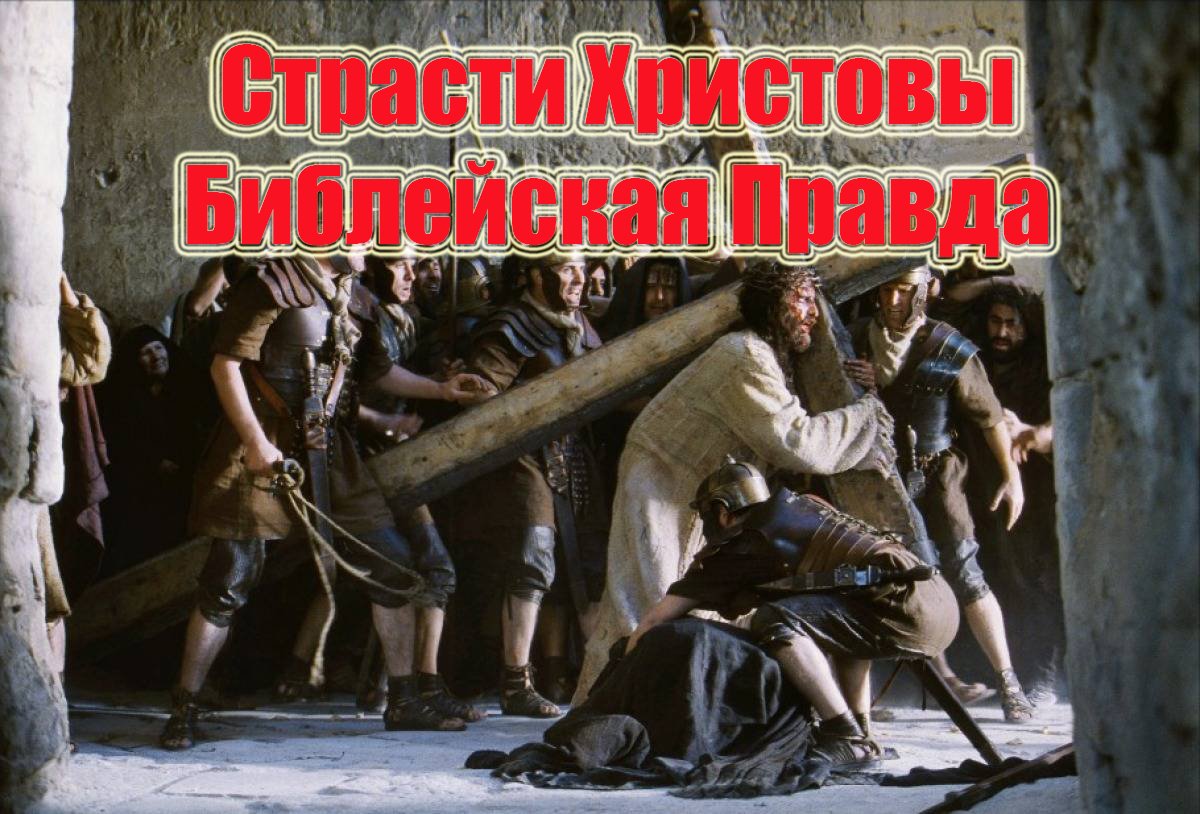
In 2004, a film notorious for its plot was released by Hollywood actor and director Mel Gibson, titled The Passion of the Christ. For many, it overturned their perception of what the Son of God endured in the last twenty hours of His life. Many, weeping, could hardly watch the film to the end, while some were unable to do so at all because of the continuous bloody horror depicted.
From a dramatic standpoint, and in comparison with other films about Jesus Christ, the movie succeeded. The world moved one step closer to the truth about the courage, suffering, and endurance of the Savior. But alas, from the standpoint of the reality recounted by the Bible as the primary source, not all viewers were able to discern the nature of the true passion of Christ. The film’s plot is saturated with the horrific abuse of the innocent Messenger of God by sub-humans, culminating in His death on the cross. One immediately gets the impression that Mel Gibson tried his best to depict what happened down to the smallest detail.
The crux of the problem lies elsewhere. In the Hollywood director’s film, there is a clear emphasis on the physical pain of the Son of God, which was not actually paramount in the Savior’s suffering. Contrary to the film’s plot, one can confidently assume that throughout human history, facts of physical abuse and violence against people can be found that far exceed those seen in The Passion of the Christ. This further confirms that the Hollywood narrative of Christ’s passion is far from the biblical one. No makeup artists, actors, or directors can film or show what the Bible calls “marred more than any man” for one reason—it is impossible. Against the background of Jesus Christ’s true pain, the mere physical suffering caused by other people, which Mel Gibson so vividly depicted, was quite insignificant. Although this does not mean that the Son of God did not experience monstrous physical pain.
What Did Christ Die From?
The pain that marred and killed the Savior was of a different nature. On the cross, Jesus lived for only a few hours, which could not help but surprise Pilate. After all, one nailed to a cross could live much longer. It is known that besides Jesus Christ, two thieves were crucified to His left and right. It was also impermissible to leave the condemned hanging on the crosses for the approaching Passover holiday. Therefore, the problem had to be solved quickly. The Roman soldiers solved it in a way that seems strange at first: “…they brake the legs of the first, and of the other which was crucified with him. But when they came to Jesus, and saw that he was dead already, they brake not his legs” (John 19:32-33).
Why was it necessary to break the legs of the two thieves, and why was this not done to Christ? The fact is that the lifespan of those crucified depended on the ability to breathe, as the breath of those nailed in such a way would be convulsively restricted by the weight of their own motionless body. Every breath was taken with horrific pain. The unfortunate person had to periodically lift themselves up by pushing against the nails in their feet. Therefore, to deprive the thieves of this possibility, the soldiers broke their legs, thereby condemning them to a faster death by suffocation.
Jesus Christ did not need this, because at that moment, to their surprise, He was already dead. To ensure the authenticity of Jesus’ death, “one of the soldiers with a spear pierced his side, and forthwith came there out blood and water” (John 19:34). According to some doctors, the water and blood flowing from the wound may indicate a massive heart attack. What did the Son of God experience that His strong heart could not withstand, causing Him to die prematurely?
According to the Holy Scriptures, the Savior experienced indescribable, monstrous pain and agony from the weight of the sins of all humanity, which fell upon Him as a curse by His own will. This was the result of a natural separation from God the Father, from whom He had never been parted, as sin and God are incompatible concepts.
That Is Why He Came
“He was oppressed, and he was afflicted, yet he opened not his mouth…” (Isaiah 53:7).
The suffering of the Son of God began even before anyone inflicted physical pain on Him. In the Garden of Gethsemane, shortly before His arrest, drops of blood and sweat appeared on Christ’s brow from agony. There, with a deep heaviness in His heart, Jesus struggled to say: “My soul is exceeding sorrowful, even unto death…” (Matthew 26:38).
This was the hour for which He was born. He not only knew this well but spoke about it to His disciples, who did not want to believe or delve into it. Jesus knew the many detailed prophecies predicted by the Holy Scriptures about His voluntary mortal fate for the sake of saving the human race from eternal destruction. The Savior also knew the specific prophecy recorded by the prophet Daniel in the 6th century BC: “…shall Messiah be cut off…” (Daniel 9:26).
Jesus not only knew but did not avoid His fate; He intentionally moved toward it. When the Apostle Peter angrily attacked one of those who came with the mob in Gethsemane, Christ stopped him, saying: “Thinkest thou that I cannot now pray to my Father, and he shall presently give me more than twelve legions of angels?” (Matthew 26:53). Peter had witnessed many miracles performed by the Lord and hardly doubted an army of a legion of angels for each apostle. The most incomprehensible thing for Peter and the other apostles was—why did their Teacher allow Himself to be illegally arrested?
Why?
“Why?”—this question arose not only among the bewildered apostles but also among His enemies: “…He saved others; himself he cannot save…” (Matthew 27:42). Why did the One who claimed to be the Christ and performed great miracles suddenly appear so helpless? “Christ on the cross is madness and absurdity. The true Christ promised by the prophets cannot be cursed, but this one is an impostor,” thought those who did not understand all the prophecies about the Savior.
“Surely he hath borne our griefs, and carried our sorrows: yet we did esteem him stricken, smitten of God, and afflicted. But he was wounded for our transgressions, he was bruised for our iniquities: the chastisement of our peace was upon him; and with his stripes we are healed. All we like sheep have gone astray; we have turned every one to his own way; and the Lord hath laid on him the iniquity of us all” (Isaiah 53:4-6).
Who Is He?
To answer “why?” for oneself, one must first answer another question: “Who is Jesus Christ?” Unfortunately, the vast majority of professing Christians have not bothered to open the Book of books to see Jesus as more than a Great Man. In the opinion of many people seen every day, the Son of God remains merely someone born about two thousand years ago through the Holy Spirit to the Virgin Mary. He died for our sins and rose again. Knowing only this, any thinking person will ask not only “why?” but also “why did He have to die for my sins?”
Here is what the Holy Scripture truly tells us about the Son of God: “Thy throne, O God, is for ever and ever: a sceptre of righteousness is the sceptre of thy kingdom. Thou hast loved righteousness, and hated iniquity; therefore God, even thy God, hath anointed thee with the oil of gladness above thy fellows.” And: “Thou, Lord, in the beginning hast laid the foundation of the earth; and the heavens are the works of thine hands” (Hebrews 1:8-10).
Based on this text, we see that the Son of God is the Great Creator God, the same as God the Father. And His birth from the Virgin Mary is merely the incarnation of the eternally existing God the Son. “And without controversy great is the mystery of godliness: God was manifest in the flesh…” (1 Tim. 3:16). Thus, if Jesus Christ is the Creator God involved in the creation of the Universe, then why should God take upon Himself the sins of our world?
Doomed to Death
It is perfectly logical that the Creator God is not only the One who created everything animate and inanimate in the Universe. He is also the Creator of various laws in nature that maintain the order and harmony of the cosmos and prevent any disharmony. As for humans, we, unfortunately, once became violators of these laws, especially moral ones. Since that time, humanity, isolated from the outside world, has doomed itself to a life mixed with tears and joy, birth and death, disease and temporary well-being. Over centuries, the human race is not only rapidly shortening its lifespan but also morally degrading.
The moral diagnosis of every person is very serious, contagious, and dangerous for the peace of the Universe. Therefore, one of the natural responsive laws to sin states: “For the wages of sin is death…” (Rom. 6:23). In other words, a sinner must be destroyed, like a cancerous tumor in a body at risk of death. Sin is a diagnosis that is not cured by forgiveness alone. What decision does the Creator and Lawgiver make?
The Town, the Criminal, and the Three Judges
Let us imagine a parable: Once, in a small town, an especially dangerous criminal appeared who caused much grief to its residents. For many years, he could not be caught. When the guards finally succeeded, the whole town breathed a sigh of relief. Now they had nothing to fear. When it came time for the trial, every resident, fearing for their future, longed for the criminal’s punishment to be the highest.
But to everyone’s surprise, the three judges, who always judged justly, saw a spark of sincere regret in the defendant. He could have been a good person if he had not fallen under the influence of daring and evil people. The judges decided that for this criminal, all was not lost. Everything possible must be done for him. Would they release him? Imagine the riot of the peaceful townspeople that such a decision would lead to. Such a decision would not only put the town in new danger but also violate the criminal code.
Therefore, the wise judges, who cared for the welfare of the town and respected the law above life, made an unpredictable decision. The Chief Judge declared: “By law, he is worthy only of death, but we are ready to forgive him!” The second judge continued: “Our law is too great and very just to be violated; therefore, in the name of the law and my favor toward this unworthy one, I have decided to stand under the death sentence instead of him!” The third judge added: “In that case, the criminal must not remain as such; therefore, I personally take responsibility to make this criminal a worthy resident of our town. He will be released and endowed with all rights and our property only after his character undergoes the entire process of change.” “The decision is final and not subject to appeal!” the Chief Judge concluded.
He Did It for Us After All!
“When I consider thy heavens, the work of thy fingers, the moon and the stars, which thou hast ordained; What is man, that thou art mindful of him? and the son of man, that thou visitest him?” (Psalm 8:4-5).
Incredible! Did the Creator God do the same? Exactly. Common sense in the story of the Son of God is that He made the decision—as the Creator of both man and the laws of life—out of love for His creation terminally ill with sin and in the name of great justice, to take upon Himself that just retribution that all humanity deserved. Becoming like us, He intentionally lived a life in poverty, but without sinning once, after which, on the appointed day, He endured a terrible separation from God the Father, the unbearable weight of loathsome sin, and finally, condemnation to the most shameful execution.
“Who, being in the form of God, thought it not robbery to be equal with God: but made himself of no reputation, and took upon him the form of a servant, and was made in the likeness of men: and being found in fashion as a man, he humbled himself, and became obedient unto death, even the death of the cross” (Phil. 2:6-8). Moreover, having risen from the dead, the Son of God, with the participation of the Holy Spirit, took responsibility to lead to repentance and change the character of all who desire it.
Who Hath Believed Our Report?
This has always seemed incredible. Therefore, the prophet Isaiah, as if on behalf of all other biblical prophets, speaks of the power of God manifested in the suffering of His Son: “Who hath believed our report? and to whom is the arm of the Lord revealed? For he shall grow up before him as a tender plant, and as a root out of a dry ground: he hath no form nor comeliness…” (Isaiah 53:1-2).
When the preaching of the crucified Savior was spread by His disciples, many did not doubt the Omnipotence of the Creator God. But they had to believe another truth: that this Almighty God is capable not only of the resurrection of the dead but also of manifesting to His creation a saving love even unto death.