Life of Society and the Individual
Humanity has imperceptibly, yet rapidly, entered an extremely extreme era of disasters, impending chaos and darkness—an era that can be called “the end of the end of earthly history.”
At the same time, it is an era of the ripening of great ideas of modern history. Everything that human wisdom has produced, everything that for centuries has captivated the minds of entire nations, must now be tested for strength. This is the time of the great final examination of the viability of all philosophical systems, world religions, forms of government, political and economic doctrines—that is, the dominant trends of human society.
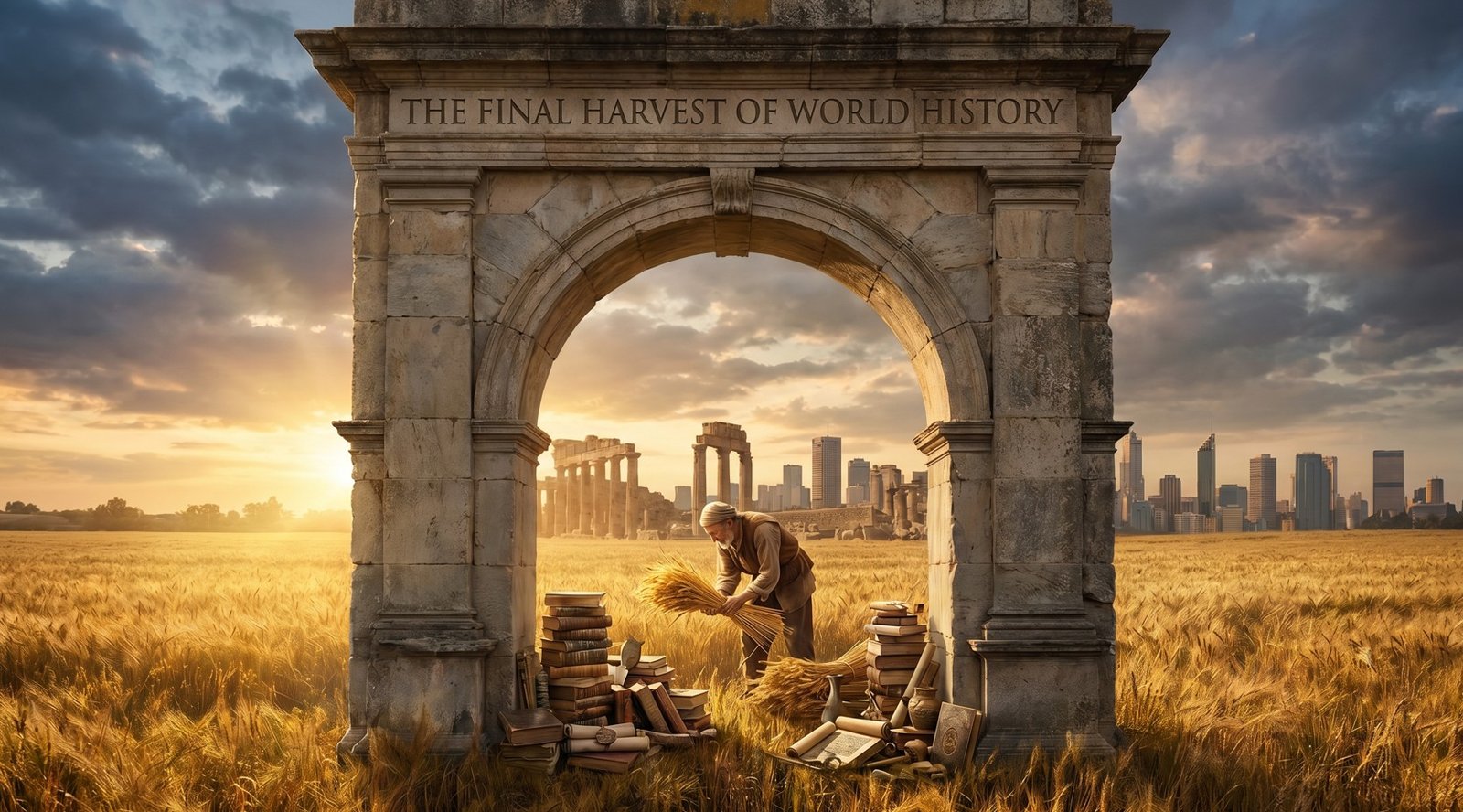
The final harvest of world history, of which Jesus Christ spoke, is approaching. “Put in the sickle, for the harvest is ripe” (Joel 3:13). “And another angel came out of the temple, crying with a loud voice to Him who sat on the cloud, ‘Thrust in Your sickle and reap, for the time has come for You to reap, for the harvest of the earth is ripe’” (Rev. 14:15). “The harvest is the end of the age, and the reapers are the angels” (Matt. 13:39).
Before our eyes, the ephemeral ideas of communism have been cast into the dust, proving fruitless like the fig tree in Matthew 21.
For a long time, among the Jewish people scattered across all continents, the idea had been ripening of creating a messianic blessed state with its center in Jerusalem, which would lead the whole world. But Zionism, which called the worldwide Jewish diaspora to gather in Israel, revealed its impotence and fruitlessness precisely in the state they created—torn apart by external and internal contradictions.
Arab unity also failed because of Shiites and Sunnis opposing one another, their protracted conflicts escalating into fratricidal wars, as happened recently between Iraq and Iran, between Iraq and Kuwait, and as is observed between Syria and Lebanon.
Today, democratic rights and freedoms demonstrate their integrity in a number of countries in Europe and America. But the era of democratic freedoms is gradually giving way to the approaching era of totalitarian control for the sake of security. Thus, in England, the country of classic European demo…[text truncated]
Today, before our eyes, the final project of globalization is being implemented, concluding the closing events of earthly history. The imposed idea of unification allegedly arises from the need to protect universal interests of survival in the face of terrorism, as well as looming economic and ecological crises…
The Gospel is Spreading Widely. The Word of God is spreading across all continents and countries, and it is addressed not only to great nations but also to small peoples.
“And I saw another angel flying in the midst of heaven, having the everlasting gospel to preach to those who dwell on the earth—to every nation, tribe, tongue, and people—saying with a loud voice, ‘Fear God and give glory to Him, for the hour of His judgment has come; and worship Him who made heaven and earth, the sea and springs of water’” (Rev. 14:6–7).
Today, most people in those countries where the gospel is being preached are faced with a final choice. No one on earth who has heard the gospel message can avoid making a decision on which his eternal destiny depends. And God, for His part, evaluates the behavior of a person who has already heard the Good News quite differently. “And that servant who knew his master’s will, and did not prepare himself or do according to his will, shall be beaten with many stripes. But he who did not know, yet committed things deserving of stripes, shall be beaten with few. For everyone to whom much is given, from him much will be required; and to whom much has been committed, of him they will ask the more” (Luke 12:47–48).
Nations that have heard the gospel message and rejected it fall into a period of hardship and disasters and are subjected to God’s judgments. One need only look at the map of natural disasters that have struck the USA and Europe with particular force in recent years. But not only these countries—other parts of the world are literally shaken by violent blows of the elements.
When the gospel is addressed “to every tribe, tongue, and people,” the whole world faces full responsibility for the path it chooses.
Increase of Knowledge, which the Lord foretold through the prophet Daniel (Dan. 12:4), is occurring in two aspects: improvement…
Loss of Historical Memory
We began our reflections with the question of the “ripening” of the world community, its entry into a special, concluding phase of world history. Based on a number of rapidly unfolding processes in the world, it can be concluded that an extreme situation has now arisen that no previous generation of earthlings has experienced.
Now the question is legitimate: why does the approaching crisis catch the human community “off guard,” psychologically unprepared to endure the coming changes?
On the eve of humanity’s final test, let us uncover some of the main reasons that have weakened and blinded both the individual and society as a whole. Let us also consider what God is doing to warn and save people from impending destruction.
The loss of historical memory of the origin of the human race is evident. This occurred as a result of rejecting the biblical teaching about the creation of the world and man by God.
The universally accepted theory of the evolutionary development of nature has deprived people of a true understanding of human origin, the highest meaning, and purpose of life. It is no accident that in our time the characteristic definition “lost generation” has appeared.
A kind of “scientific eclipse” began in the mid-19th century. And at the same time, God establishes His Church for the worldwide preaching of the gospel and the proclamation of the three angels’ messages from Revelation 14. The first angel says loudly: “Worship Him who made heaven and earth, the sea and springs of water.” This is a call to restore the historical memory of the origin of the Earth and the human race, to return to the Bible and unshakably trust what God said in the first chapters of Genesis. It is necessary to believe the entire Word of God, despite mass idolatry adorned with unproven hypotheses. To worship the Creator means to acknowledge…
The Meaning of the Concept “Church”
The original meaning of the word “church” is connected with the ancient Greek word ekklesia, found in New Testament manuscripts, where ek means “from” or “out of,” and klesis means “to call,” or “those who are called.” Therefore, it is quite obvious that the word “church” (ekklesia) points to the action of heavenly power among people, with the purpose of calling (klesis) them out (ek) of the world of sin into the world of the Gospel. Thus, the church represents the highest degree of human privilege and power in the spiritual realm. This is exactly what Jesus had in mind when He announced the establishment of the Church.
The Church of Our Time
The origins of the appearance of God’s Church in the distant past are astonishing. But what about the present? The prophecies of the biblical book of Revelation unequivocally speak of His Church, which will survive, endure, and stand through all the vicissitudes of fate that have fallen to its lot. Moreover, the book of Revelation reveals to the modern seeker the characteristic features of God’s Church and its destiny for our days.
Three Messages to Our World
The Lord singled out His Church against the background of religious cacophony by entrusting it with the right to proclaim and convey to the whole world, on His behalf, three special messages described in Revelation chapter 14, verses 6–12. The main content of this message is that God offers humanity, puzzled by global problems, a solution, and it is revealed in the Everlasting Gospel. The essence of the Gospel was most vividly revealed on the Cross of Calvary, where our Savior was crucified more than two thousand years ago. There, on the cross, He as the Lawgiver gave Himself as a sacrifice to redeem people for the law they had broken. There He voluntarily paid for our “righteousness” as sinners, taking upon His account all our vices, and in return, placed His true righteousness upon our account. Therefore, we are alive to this day and have the right to choose: to accept this substitutionary sacrifice of the Savior as the greatest fact of history or not.
The Birth of Christ’s Church
This event occurred on the Day of Pentecost (the fiftieth day after the resurrection of Jesus Christ), when, as the Gospel says, the Holy Spirit descended on the followers of Jesus. In reality, this was the return of the Great Teacher to His disciples through the Holy Spirit. Jesus had spoken of this earlier: “I will not leave you orphans; I will come to you. A little while longer and the world will see Me no more, but you will see Me; because I live, you will live also.”
The Day of Pentecost is the meeting place of promise and fulfillment. What Jesus spoke of then happened. What an amazing blessing it is to know that with the coming of the Holy Spirit on that day is connected the formation of the Church as a historical reality. It was the transformation of timid, confused, and disappointed disciples into bold evangelists, able to persuade by the power of word and Spirit. It was the conversion of many mockers and opponents of Christ into His supporters. It was the endowment of amazing joy, love, and unity to a multitude of people who had previously been strangers to one another. It was the building of a community of people dwelling in a conscious union of faith with one another and with Christ. All this came with the appearance of Christ’s Church.
The Historical Mission of the Church
The mighty power of the Holy Spirit and the love of Christ in the stream of life of God’s followers were directed into the sinful world for its renewal. Over time, this stream expands, watering the fallen world with the dew of the preaching of the Gospel. People of all races, nations, and classes are called to join the living, breathing organism—the Church—which is filled with faith and a passion to save. This is the greatest fact of human history.
Final Thought from the Document
God is waiting for our decisions. Realizing ourselves as God’s children, we must return to the Father like the prodigal son, “so as no longer to feed swine at the philosophers’” (H. Heine, “Deathbed Confession”).
There is plenty of “food for thought.” God is waiting for our decisions.